
The Place Where Every Worldview Begins
If you trace any worldview back to its root, it eventually asks you to just trust something right out of the gate.
Materialism asks you to put your faith in matter. It operates on the idea that the physical universe is the absolute baseline of reality, and consciousness is just a byproduct that booted up much later once biological matter got complex enough. Idealism flips this and asks you to trust consciousness instead. It suggests that our subjective experience isn’t some late-stage evolutionary accident, but rather the foundational canvas upon which the universe actually appears.
Most of us instinctively side with materialism without really thinking about it, and honestly, that makes total sense. Materialism carries the immense, undeniable prestige of modern science. Because we assume the physical world is fundamental, we’ve been able to map the human brain, split atoms, cure diseases, and launch satellites. The physical world gives us hard math, reliable instruments, and highly predictable results. Next to that kind of track record, idealism can easily sound suspicious before it even makes its case, like mysticism trying to sneak in wearing a philosophy trench coat.
But the tension starts the moment we slow down and ask one basic question: What do we actually have direct access to?
Before you can form a theory about matter, before you can look at a brain scan or read a scientific paper, there is experience. You are aware. You are reading these words right now, perhaps feeling a sense of agreement, resistance, or curiosity. All of that happens exclusively inside consciousness.
Pointing this out doesn’t automatically prove idealism, but it does something much more uncomfortable. It reveals that consciousness is the unavoidable doorway through which every single claim about reality has to pass.
Whatever reality ultimately turns out to be, we never actually start our investigation from raw “matter.” We always start from experience.
I built a Worldviews Matrix tool for you to compare these worldviews more directly.
The Strength of the Materialist Story
It would be intellectually dishonest to pretend materialism doesn’t have a fiercely compelling story.
According to this view, the universe existed long before any minds were around to witness it. Over unimaginable stretches of time, stars burned out, chemistry grew more complex, and eventually, nervous systems developed until brains became sophisticated enough to literally “wake up.” In this framework, consciousness isn’t fundamental at all. It is just a late development in nature—what happens when matter reaches a highly specific level of biological organization.
And practically speaking, this story works exceptionally well.
If a person’s brain is physically damaged, their entire personality can irreversibly change. We know that injuring specific neural regions can destroy memory or self-control. Anesthesia can switch consciousness off like flipping a breaker, and a chemical shift from a drug can completely distort your sense of time and identity. Sleep deprivation, trauma, and neurological diseases all point to a deeply physical root for our inner lives.
These are serious, heavy facts. You can’t just wave them away with vague spiritual language. Anyone who wants to challenge the materialist worldview has to look these brutal facts dead in the eye.
The materialist looks at this mountain of evidence and says the conclusion is obvious: change the brain, and the experience changes. Shut down the brain, and consciousness disappears. Therefore, the brain doesn’t just host the mind—it physically produces it.
That conclusion feels completely airtight… right up until we ask how, exactly, we know the brain is actually there.
The Brain Also Appears Inside Experience
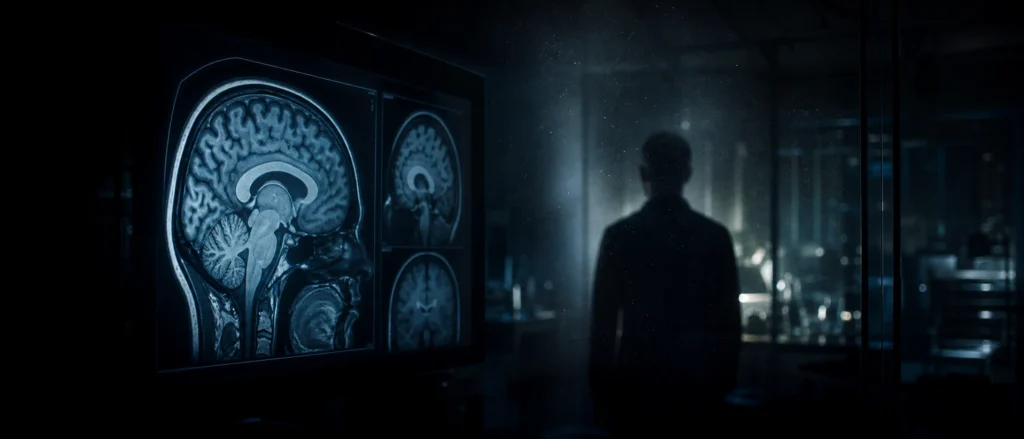
At first glance, asking “How do we know there is a brain?” sounds ridiculous. We can scan it, surgeons can physically touch it, and neuroscientists can map its electrical activity.
But the catch—the one materialism often glosses over—is that every single one of those observations arrives to us as an experience.
The MRI image is something you perceive visually. The scientific paper is processed through your own thought and perception. When a surgeon holds a physical brain in their hands, that tactile observation is happening entirely within their own conscious awareness. Even the grand, logical conclusion that “the brain produces consciousness” is simply another concept floating inside a conscious mind.
This is where the ground gets a lot less stable than materialists usually like to admit. The prevailing theory claims that matter is the foundational reality and consciousness is just a secondary byproduct. Yet, every piece of evidence we have for matter is delivered exclusively through consciousness. We never actually encounter matter outside of our experience of it. The brain—the very organ that is supposed to explain the existence of consciousness—is itself encountered exclusively as an object within consciousness.
That doesn’t make the brain a fake illusion, and it doesn’t mean science is a lie. But it does mean the relationship is infinitely more tangled than the standard scientific narrative suggests. The exact thing we are trying to explain is also the mandatory condition for any explanation to exist at all.
Observation, Inference, and the Hidden Leap

A careful materialist has a solid counter-argument here. They will usually point out that yes, while all our evidence arrives through experience, that is just how human knowledge works. We don’t need direct, unfiltered access to raw matter to know it’s there. We infer that an external physical world exists because it is the absolute best explanation for why our experiences are so stable, why observers agree on things, and why physics is so flawlessly predictive.
It’s a strong, serious reply. But it also exposes a hidden leap of faith.
The physical world is not directly given to us. It is an inference. It might be the strongest, most necessary model we have to navigate life and build technology, but it remains a working model constructed out of our experiences.
Consciousness holds a completely different status. It isn’t an inference. It is the one immediate, inescapable fact.
You can doubt the external world, you can doubt your senses, and you can doubt your memories. But you cannot doubt the presence of your own experience, because the very act of doubting is an experience itself.
This is why idealism can’t just be casually dismissed. It begins with the one thing we literally cannot step outside of, and it asks a very precise, non-mystical question: Why are we so eager to explain the only thing we know directly (our minds) by using a concept we only ever know indirectly (matter)?
The Hard Problem Still Stands
Even if we eventually map every single neuron and grant every future discovery of neuroscience, a massive void remains: Why should physical biological activity feel like anything from the inside?
A neuroscientist can show you exactly which regions of the brain light up when you see the color blue or feel physical pain. Those correlations are incredibly useful. But correlation is not explanation. A complete physical description of the brain tells us which chemicals were released and which electrical signals fired. It beautifully explains the mechanics of human behavior. What it entirely fails to explain is why any of that data processing is accompanied by a subjective experience.
Why isn’t it just dark inside? Why is there a felt inner life rather than just a biological robot processing external stimuli?
This is the famous “hard problem” of consciousness. It’s not about how the brain processes data; it’s about why that processing has a subjective, first-person side to it.
The default materialist answer is usually to point to “emergence”—the idea that when matter gets complex enough, consciousness naturally emerges. People often compare this to how biological life emerges from complex chemistry, or how weather patterns emerge from air pressure.
The problem is that properties like biology or fluid dynamics can still be completely described from the outside. Consciousness is fundamentally different because it is anchored to a first-person perspective. The crushing weight of grief, the subjective taste of coffee, the strange intimacy of a private thought—these aren’t external behaviors you can measure with a ruler. They are lived from within.
So when someone claims consciousness just “emerges” from dead matter, you have to ask what exactly is being explained. Right now, the word emergence often functions less like a scientific mechanism and more like an IOU—a placeholder where an actual explanation is supposed to arrive later.
Consciousness Does Not Behave Like an Object
A massive part of the friction here is that consciousness absolutely refuses to behave like the things we usually study in science.
Matter has location, mass, and coordinates in space. It can be divided, heated, accelerated, and observed objectively from the outside. Consciousness does not present itself this way. A thought doesn’t weigh anything. The feeling of the color red doesn’t take up physical space. While pain correlates with brain activity, the actual sensation of pain isn’t something a surgeon can physically extract and hold up to the light.
You can put a piece of brain tissue under a microscope, but you can’t put awareness under a microscope, because the microscope, and the scientist looking through it, are already appearing inside awareness.
This doesn’t mean consciousness is some supernatural ghost. It just means it doesn’t fit into the category of “objects.” You can observe a chair, a star, or a human brain. But awareness itself is the invisible condition that allows observation to happen in the first place. The second you try to pin it down and look at it, you’re already actively using it.
Materialism is a brilliant framework built from the ground up to explain objects and mechanical processes. But consciousness is the field in which objects and processes are known. Trying to force the ultimate observer into an objective framework might be the root of the entire problem.
The Dream Problem

If you want a visceral sense of how deep this goes, look at dreams.
When you fall asleep, your mind can generate an entire, immersive reality. You experience gravity, architecture, conversations, and physical threats. While you’re locked inside the dream, that world feels entirely external. You don’t walk through a dream city thinking, “These buildings are made of my own awareness.” You just experience them as solid, external reality. It isn’t until you wake up that you realize the entire universe you were just walking through was mind-generated.
Obviously, this doesn’t prove waking life is just a dream. A materialist would rightly point out that dreams are just the sleeping brain processing things, which is a totally coherent answer.
But it does prove something critical: our consciousness is fully capable of generating a reality that feels 100% external and physical while we are trapped inside it.
This completely undercuts one of materialism’s most casual assumptions.
Just because the waking world feels like it exists outside of us doesn’t automatically prove that it does. Dreams prove that the sensation of “externality” can be seamlessly faked by the mind.
For idealism, this is a massive opening. It forces the question: What if waking life isn’t a private dream happening in a single brain, but rather a shared, structured appearance inside a deeper form of foundational consciousness? What if matter isn’t the invisible bedrock beneath reality, but simply the highly consistent, structural rules of our shared experience?
The Problems Idealism Must Face

But idealism carries its own incredibly heavy baggage.
If the universe is fundamentally made of mind, why is the physical world so relentlessly stubborn? Why doesn’t reality warp and shift based on our private fears and desires the way a lucid dream does? Why do different observers agree on what they see? Why does a physical blow to the head alter the mind so predictably, and why does mathematics map onto nature with such chilling precision?
These aren’t small issues. A weak version of idealism tries to dodge them by hiding behind mystical, vague language. But a serious version has to actually do the heavy lifting of explaining why an experience entirely made of “mind” insists on operating by strict physical rules, consequences, and shared limitations. It has to explain why the physical body dictates so much of our existence if consciousness is supposedly the primary force.
So, neither worldview walks away clean.
Materialism perfectly explains the rigid structure of the universe, but completely fails to explain how dead matter wakes up and starts feeling things. Idealism respects the undeniable primacy of our conscious experience, but struggles to explain why reality is so stubbornly physical. One side can’t explain the observer; the other side can’t explain the structure.
Why Materialism Is Not the Neutral Position

It has become incredibly common to treat materialism as the default, logical baseline—as if it’s simply what is left over once you strip away religion and superstition. I don’t think that is a fair assessment anymore.
Materialism is a massive metaphysical commitment. Claiming that invisible, unconscious matter is the absolute baseline of reality, and that it magically produces subjective life, is an interpretation of the facts. It is not a neutral, objective fact itself.
Science provides us with extraordinary, life-saving models of the patterns we experience. It tells us what behaves how, what can be predicted, and what can be repeated. But whether those patterns are ultimately grounded in dead matter, pure consciousness, or something else entirely is still a massive philosophical debate.
When materialists accuse idealists of taking a massive leap of faith, they are absolutely right. But when idealists point out that materialism requires a leap too, they are also right. The honest truth is that both sides require an assumption. The real conversation shouldn’t be about who is avoiding a leap, but rather which leap makes the most sense of the totality of the human experience.
The Tension We Actually Feel
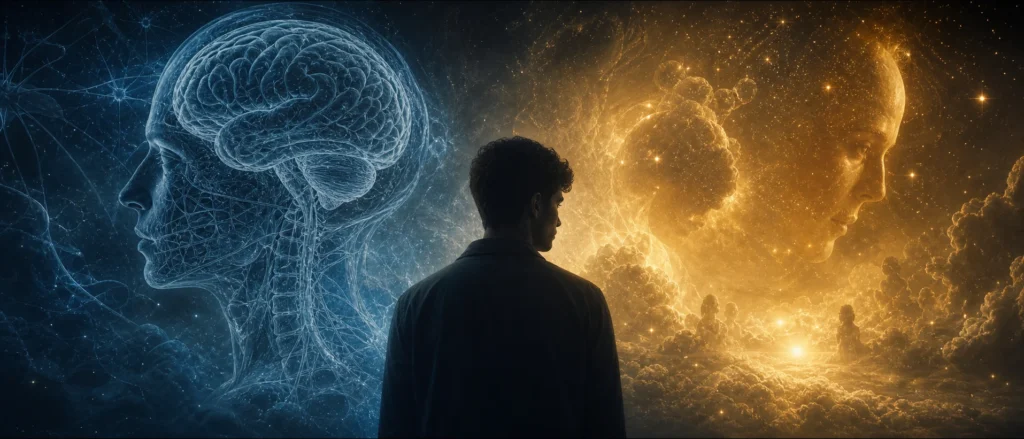
This tension isn’t just an abstract puzzle for academics. It is something anyone who pays attention can feel directly.
On one side, the physical world feels undeniable. If you don’t eat, you starve. Sleep badly, and your whole reality warps. Eat, breathe, bleed, age, and get sick—the body isn’t a cheap illusion, and the physical world has brutal consequences.
On the other side, everything we call “physical” is known exclusively through experience. The body itself is felt through sensation, and the brain is only ever encountered as a concept or image within awareness. Matter is incredibly predictive and powerful, but it is still entirely fenced inside consciousness.
So we end up caught in a strange, dizzying loop. The brain seems to produce consciousness, but consciousness is the only place where the brain appears. Both of those statements feel true in entirely different ways. Put them together, and the simple picture of reality completely fractures.
No Easy Victory

It is tempting to just pick a team and end the debate.
It is easy to point to neuroscience, declare consciousness a solved biological function, and move on. It is equally easy to declare that “everything is mind” and ignore the rigid, physical suffering of the real world. But both of these are premature victories that protect the ego rather than seeking the truth.
The honest position is much harder to sit with because it doesn’t give either side a clean win. Materialism is way too successful to write off, but idealism is way too profound to ridicule. Matter is too stable to wave away, yet consciousness is too immediate to casually reduce to a biological byproduct. The mystery outlives every cheap answer we try to throw at it.
Standing Inside the Unresolved Question
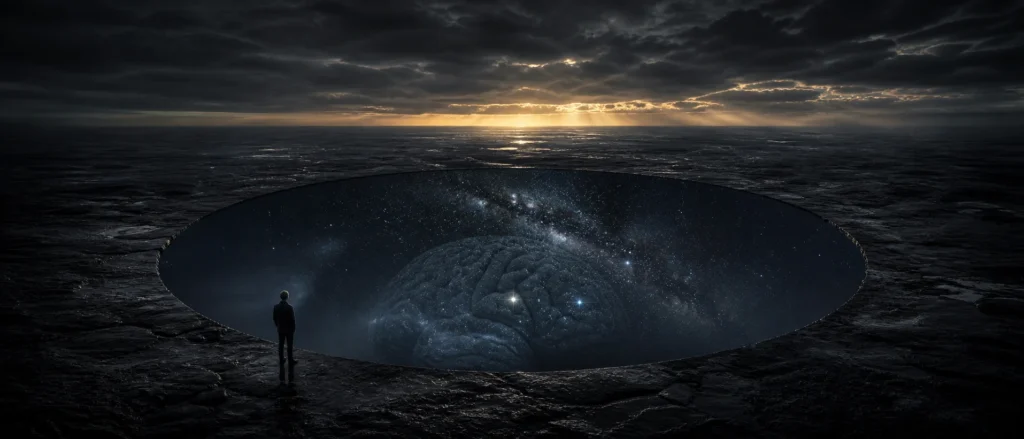
I constantly find myself pulled by the gravity of both sides.
Ignoring the explanatory power of materialism would be childish; it built the modern world we live in. Yet, every attempt to reduce the sheer miracle of conscious experience down to dead matter always feels like it leaves the core mystery untouched. The observer is always assumed before the scientific explanation even begins. That circularity doesn’t destroy materialism, but it should profoundly humble it.
At the same time, idealism gives consciousness the priority it clearly has in our direct, lived lives. It starts from the only thing we know for sure. But it must be disciplined by the reality of stubbed toes, shared physics, and brain damage.
Maybe one day we will develop a new framework that makes this entire conflict look primitive. Maybe matter and consciousness are just two sides of a much deeper coin that we don’t even have the vocabulary to name yet. But until that happens, the tension isn’t going anywhere.
(I opened a discussion on the Inner Circle for anyone who wants to sit in this tension further, challenge the argument, or bring a new perspective to it.)


